



Ninja Stealth Watch

Because they are so specialized, these watches are not practical for most people. This is the
unfortunate fate of the “incredibly specialized watches” featured in this exhibition.
However, imagine if we associated these timepieces with a fictional character that anyone could
easily picture—wouldn't that spark intrigue and captivate a wider audience?
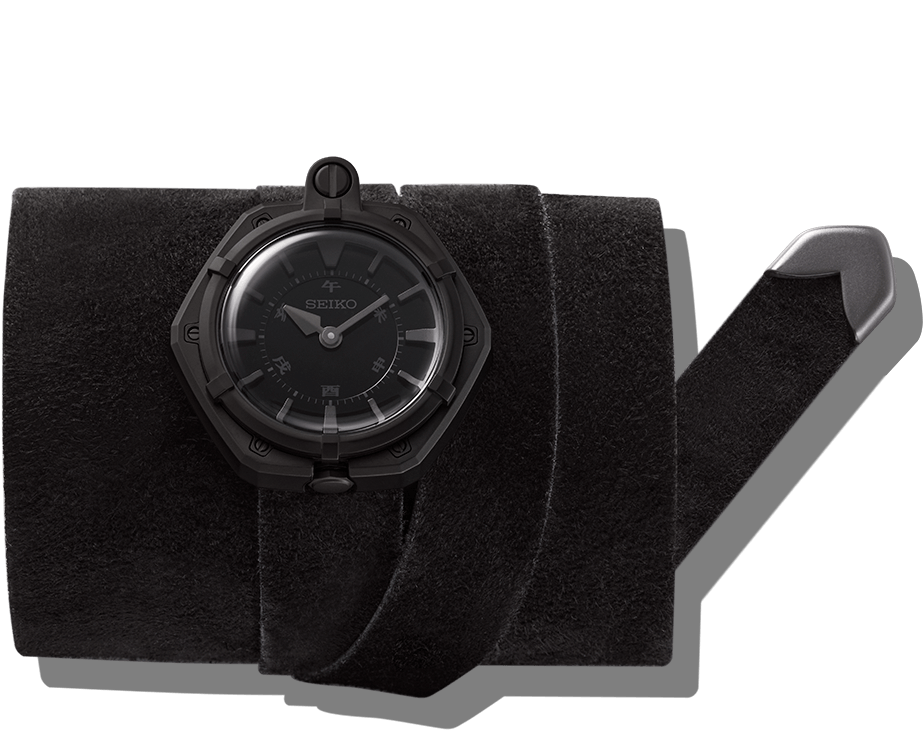
This idea led to the creation of the Ninja Watch. I envisioned it as a cool timepiece that would
appeal to international audiences, while strongly projecting Japanese iconography.

 The cover opens and closes by sliding and the time is read by
directly touching the hands and hour markers.
The cover opens and closes by sliding and the time is read by
directly touching the hands and hour markers.
So, what are the essential functions of a watch for ninjas? I concentrated on the ability to tell time discreetly, particularly in complete darkness. The first solution that comes to mind is Lumibrite (luminous paint), but the risk is that the light could reveal your presence to an enemy. Additionally, you wouldn’t want to take your eyes off your target to check the dial. With this in mind, I developed the design concept of a tactile watch, allowing the wearer to read the time using only their sense of touch.

 The strap,
crafted from deer leather and inspired by the method of securing and loosening a Japanese
archery glove, can be adjusted to fit arms of various thicknesses while also providing
protection to the area where it is worn. As the watch is read by touch, it can be worn not
only on the wrist but also on other areas of the body, such as the upper arm or
ankle.
The strap,
crafted from deer leather and inspired by the method of securing and loosening a Japanese
archery glove, can be adjusted to fit arms of various thicknesses while also providing
protection to the area where it is worn. As the watch is read by touch, it can be worn not
only on the wrist but also on other areas of the body, such as the upper arm or
ankle.Initially, the design was similar to a regular watch, as I thought that a watch that looked too ninja-like could expose their identity. However, I gradually shifted my thinking toward a watch that fully embraces the traits of various ninja tools. This evolution led to a rugged yet iconic design, centered around the keyword “tool-like.” The metal cover features the family crest of the lord to whom the ninja is loyal, and the watch includes playful touches, such as the unconventional use of a black color scheme that makes the entire watch hard to see.
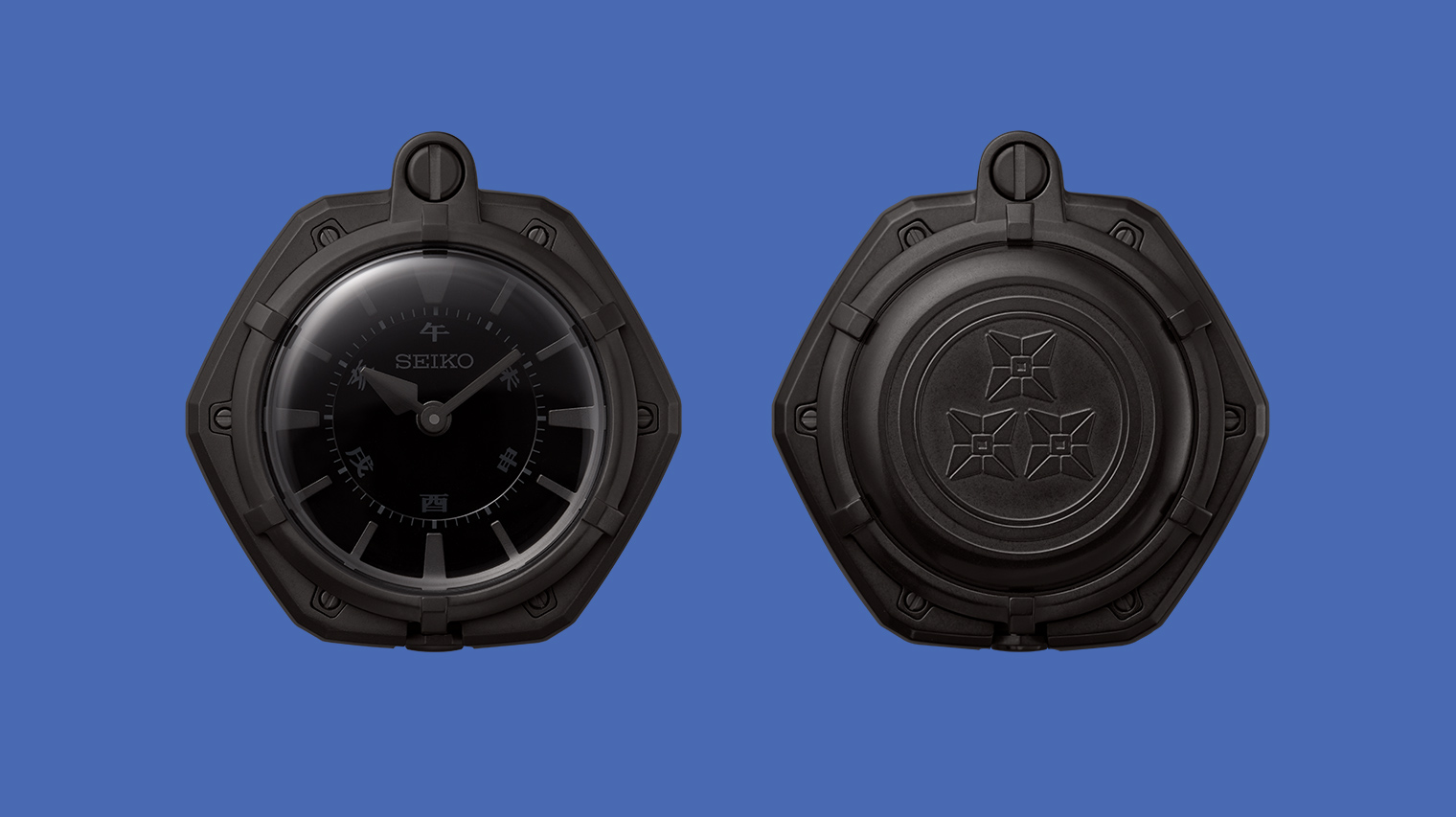 Two
types of lids available: one with a glass lid (left) that allows you to check the time by
sight, and a metal lid (right) that offers resistance to external shocks. The metal lid is
decorated with an emblem representing the family crest of the house that the ninja serves.
For this piece, the designer has incorporated his own family crest into the design, creating
an original graphic that subtly incorporates ninja-like elements.
Two
types of lids available: one with a glass lid (left) that allows you to check the time by
sight, and a metal lid (right) that offers resistance to external shocks. The metal lid is
decorated with an emblem representing the family crest of the house that the ninja serves.
For this piece, the designer has incorporated his own family crest into the design, creating
an original graphic that subtly incorporates ninja-like elements.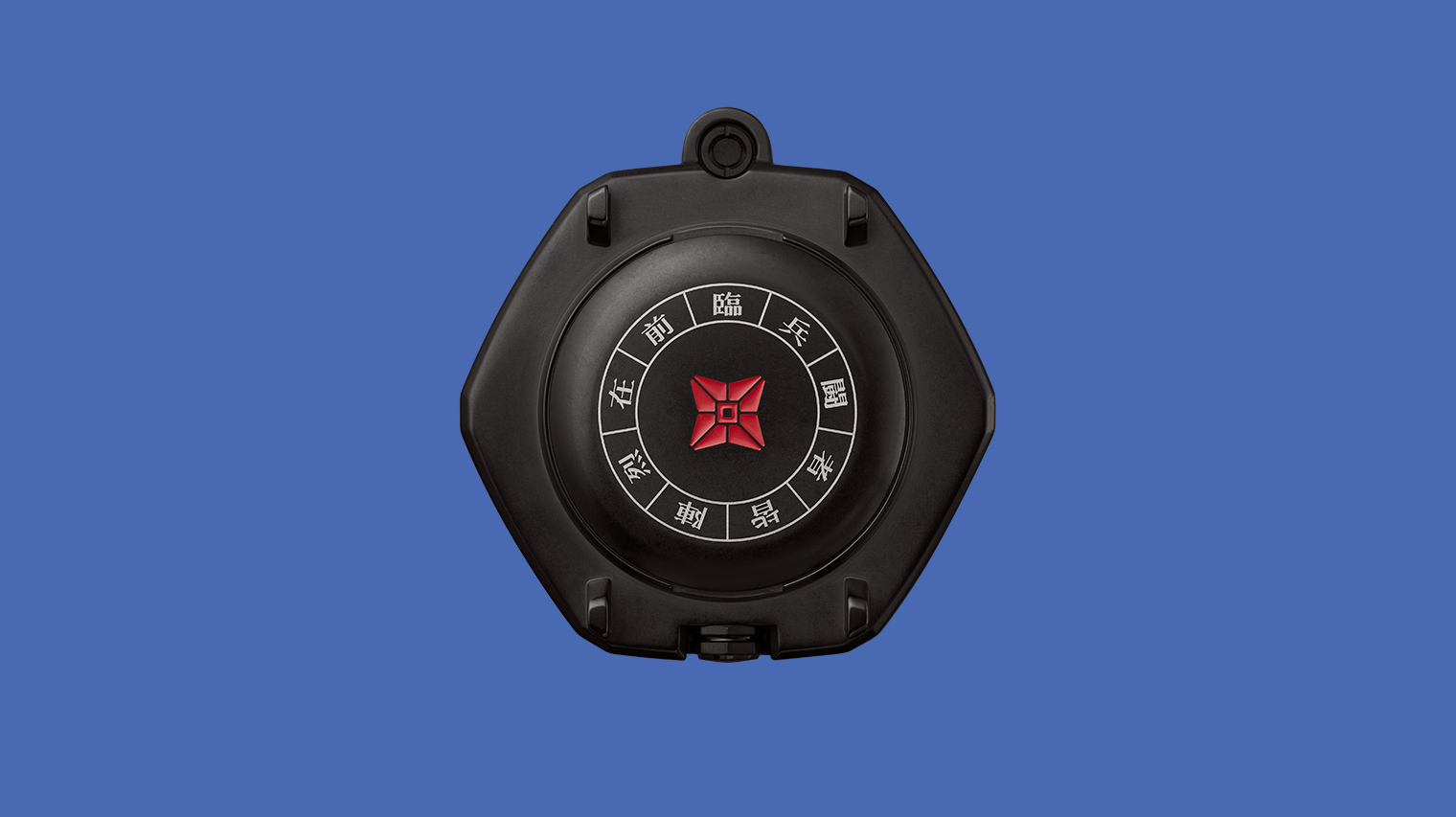
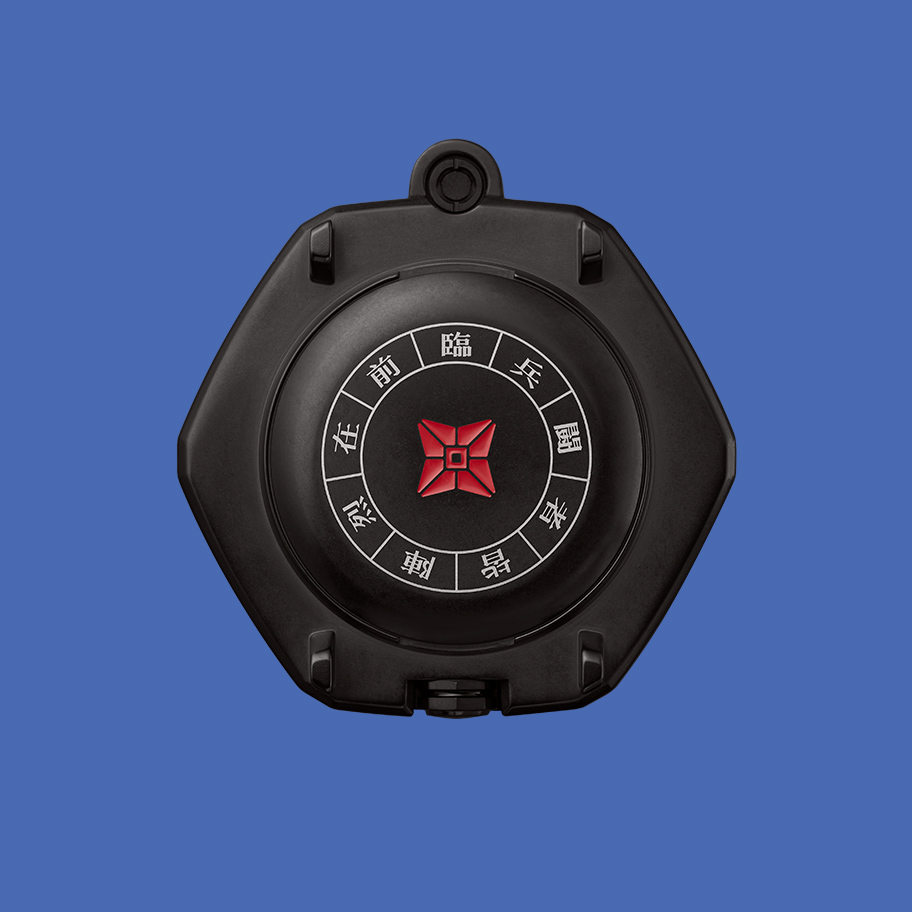 On the back of the case, there is a spell used by ninjas to focus their
minds, accompanied by a graphic of a red shuriken. This single vivid element, concealed
within an otherwise all-black color scheme, subtly symbolizes the ninja's intense
fighting spirit.
On the back of the case, there is a spell used by ninjas to focus their
minds, accompanied by a graphic of a red shuriken. This single vivid element, concealed
within an otherwise all-black color scheme, subtly symbolizes the ninja's intense
fighting spirit. Expert’s Comments
 Nindōka, Practitioner
 of the Ninja Way Mr. Narashino Seiryukutsu
Wristwatches didn’t exist in the era when ninjas were active. So, how did they tell
time?
Ancient ninjutsu texts contain teachings on timekeeping. According to
Bansenshūkai, a 1676 compilation of writings on ninjutsu (the traditional art
of ninja skills) from the historic regions of Iga and Koga, famous for producing
some of the most skilled ninjas, ninjas measured time by such methods as observing
the position of the Big Dipper, using tools like weights and hourglasses, and even
judging whether their breath passed easily through their nose. For instance, they
identified the time when their breath passed through the left nostril during Ne no
Koku, Hour of the Rat (basically an hour segment corresponding to 11:00 p.m. to 1:00
a.m. in the traditional Japanese timekeeping system), alternating nostrils with each
subsequent hour segment. Additionally, they used the changing shapes of a cat's
eyes, which adapt to surrounding light, as a timekeeping reference. These
shapes—resembling a circle, an egg, a Japanese persimmon seed, or a needle—were
immortalized in the traditional counting song Neko no Me Uta (Cat's Eye
Song).
In those days, measuring time was a challenging task. How much easier it would have
been with such a remarkable watch as this! The way it’s worn immediately caught my
attention—featuring a traditional design, it is secured with a string, much like a
Japanese archery glove. What impressed me even more was the tactile method of
telling time by feeling the hands with your fingertips. In our training, we often
practice sensing objects while blindfolded to heighten our awareness as part of a
tactile exercise. This watch would be ideal for that kind of exercise. If it ever
becomes a reality, I’d certainly want one for my work!
 Designer

Yuya Suganuma
Suganuma joined Seiko in 2021 and is currently responsible for designing Seiko brand products, with a focus on Seiko 5 Sports.